

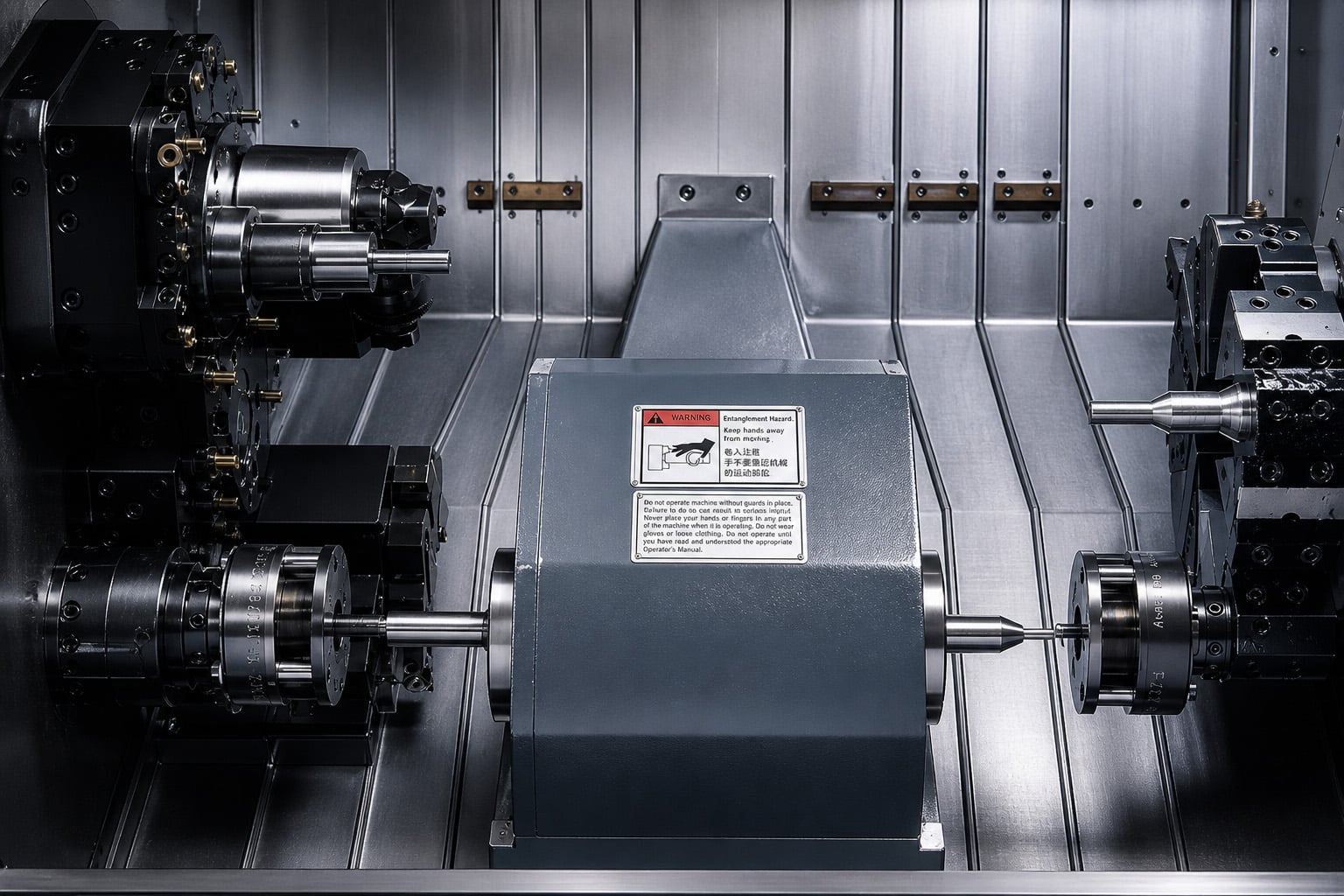
As global shaft production volumes scale toward a projected USD 30.94 billion market by 2035, OP10 automation has become the defining variable between a line that scales and one that quietly limits output. The first operation — facing and centering — determines the center-hole reference that every downstream process inherits. Miss it here, and no amount of precision at grinding or finishing will recover it.
OP10 automation at the facing and centering stage is where total shaft quality is determined. Every datum, every tolerance, and every downstream decision starts from the center hole established at OP10.
For production engineers running high-volume shaft lines — motor shafts, piston rods, hydraulic tubes, balance shafts — the architecture of your OP10 setup is either enabling throughput or exposing it to systemic error.
In production engineering, OP10 is operation number one: typically facing and centering, where both ends of a shaft blank are faced flat and center holes are drilled to create the reference datums used by every operation that follows. Get OP10 right, and the rest of the line runs consistently. Get it wrong, and grinding rejects, runout failures, and downstream scrap follow predictably.
Chips trapped in the fixture or a misaligned tool spindle can shift the center-hole reference, directly compromising OP10 accuracy. Because every downstream operation builds on that same reference, the error doesn't stay contained — it carries forward and compounds at each step.
The facing and centering step is increasingly where production bottlenecks first appear — not because the machine is broken, but because the architecture of traditional facing and centering equipment was not designed for today's tolerance requirements or production rhythms.
As shaft geometries become more demanding, conventional facing and centering setups encounter accuracy limits that are difficult to control consistently across shifts and batches. Four structural challenges stand out:
These are not isolated setup issues. They are structural — built into where the accuracy reference is created and how many variables the machine architecture leaves exposed.
Conventional vs. TL10 at OP10
| Conventional | TL10 | |
|---|---|---|
| Cycle Time | Baseline (~40 sec) | Up to −60% (<18 sec) |
| Center Hole Accuracy | ~±0.05 mm | ±0.01 mm |
| Setups per Part | 2 setups | 1 setup — both ends done |
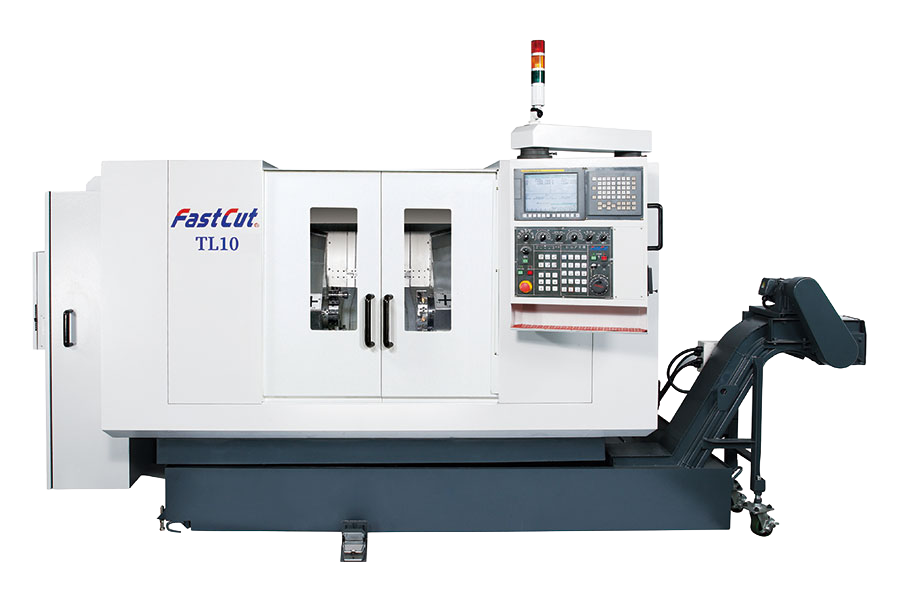
The TL10 Center Drive Lathe is designed to address the structural limitations of conventional facing and centering machines. Equipped with a 12-station servo turret, Fanuc controller, and linear guideway slides for high-speed Z/X axis movement, the TL10 delivers precision OP10 automation for piston rods, hydraulic tubes, and motor shafts up to Φ80 spindle bore.
01. Dual-End Machining from One Rotational Reference
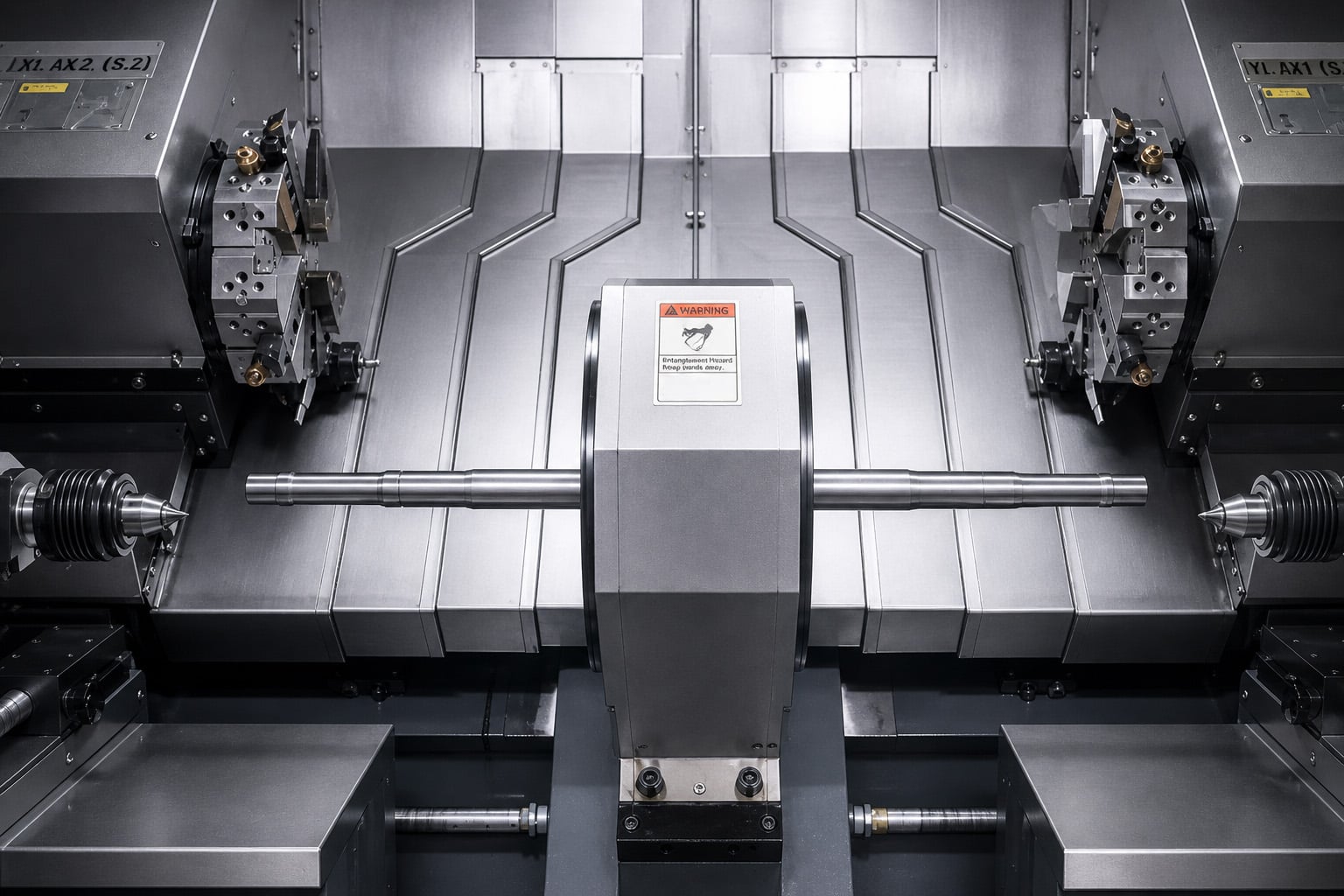
In the TL10, both ends are machined in a single setup while the workpiece rotates on a high-precision main spindle. Instead of relying on two independently aligned rotating tool spindles, the process uses one stable rotational reference — keeping the benefits of simultaneous dual-end machining while making concentricity easier to set, verify, and maintain.
02. Consistent ±0.01 mm Centering Precision
Because the workpiece rotates from the main spindle, centering accuracy is built around spindle bearing precision rather than repeated tool-side alignment. With fewer alignment variables in the process, ±0.01 mm accuracy is easier to sustain across operators, shifts, and production batches — a direct answer to the batch-to-batch drift problem of conventional OP10 setups.
03. Programmable Changeovers
Different shaft specs call up the corresponding program — no manual cam adjustments, no re-setting stops. Changeover time drops from hours to minutes, making high-mix shaft production viable without sacrificing throughput or reintroducing alignment risk with every job change.
04. High-Pressure Coolant and Automation-Ready Design
Compatible with 70 Bar high-pressure coolant and servo tailstock options, the TL10 integrates cleanly into automated loading and unloading systems — enabling continuous, lights-out OP10 automation for high-volume lines.
Consider a motor shaft line producing 500+ parts per shift, with tight runout requirements at downstream cylindrical grinding. Running OP10 on a conventional manual facing machine, cycle time sits around 40 seconds per part. Center hole positioning is exposed to chip interference, fixture condition, and tool spindle alignment — and when the center reference shifts, grinding rejects consistently trace back to centering deviation at OP10.
After introducing the TL10 at OP10, cycle time drops below 18 seconds. Center hole accuracy holds at ±0.01 mm across the full batch. Grinding rejects attributable to OP10 fall below 1%.
The improvement doesn't happen at grinding — it happens because a better datum was established from the start. When OP10 automation is reliable, the entire line benefits.
If your shaft production line is running into OP10 bottlenecks — inconsistent centering, fixture-related positioning errors, or two-end alignment challenges — the TL10 is a purpose-built answer. For a closer look at Fastcut's approach to production technology and the full TL10 center drive lathe specifications, explore the relevant pages on the Fastcut website.
For broader context on machining datums and reference systems, readers may also refer to the CNC machining overview on Wikipedia.
Q: What is OP10 automation in shaft machining?
OP10 automation refers to automating the first operation on a shaft production line — typically facing and centering — using a CNC machine to establish the center-hole reference datums without manual intervention. Reliable OP10 automation removes human variables from the most critical step in the process, ensuring every part starts from a consistent, accurate reference.
Q: Why does OP10 accuracy affect downstream grinding quality?
The center holes drilled at OP10 serve as the reference datums for all subsequent operations, including cylindrical grinding. If those center holes are positioned inconsistently — due to chip interference, spindle misalignment, or fixture wear — the part is already out of true before grinding begins. A grinder cannot correct a bad datum; it can only machine relative to it.
Q: How does the TL10 improve OP10 automation over conventional machines?
Unlike conventional facing machines that rely on two separately aligned rotating tool spindles, the TL10 rotates the workpiece on a single high-precision main spindle. This eliminates two-end alignment variation and reduces the number of accuracy variables in the process — allowing ±0.01 mm centering precision to be maintained consistently across batches and operators.
Q: Can OP10 automation support high-mix shaft production?
Yes. The TL10's programmable changeover capability allows different shaft specifications to be loaded via program call — eliminating manual cam adjustments and reducing changeover time from hours to minutes. This makes OP10 automation viable for high-mix lines without sacrificing accuracy or throughput when switching between part numbers.
If you are based in the North America , feel free to reach out to our local partner

|